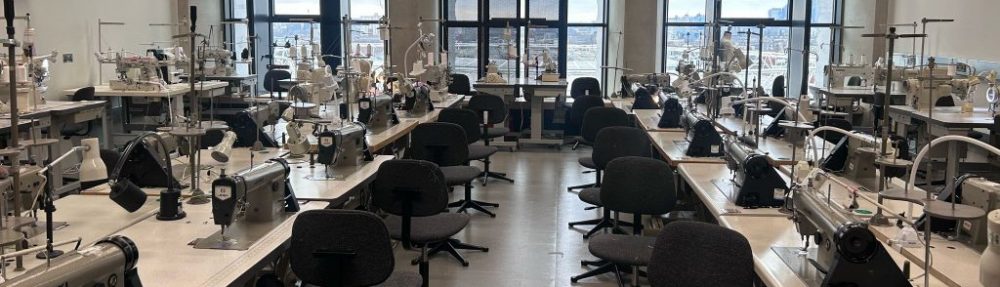
Session to be observed: 27th February 2025 – Technical workshop. Basque part 2, BA Fashion Contour year 1 group B., 9.30am – 12.30pm.
Size of student group: 20
Observer: Karen Matthewman
Observee: Jade Gellard
Note: This record is solely for exchanging developmental feedback between colleagues. Its reflective aspect informs PgCert and Fellowship assessment, but it is not an official evaluation of teaching and is not intended for other internal or legal applications such as probation or disciplinary action.
Part One
Observee to complete in brief and send to observer prior to the observation or review:
What is the context of this session within the curriculum?
I am delivering the second part of a three – part workshop, where I demonstrate how to make a Basque, and students complete their own sample for hand in to be assessed.
How long have you been working with this group and in what capacity?
This is a 1st year class – September 2024. 5 months.
In the capacity of delivering the groups technical workshops.
What are the intended or expected learning outcomes?
The intended learning outcomes:
- Students learn new construction techniques.
- Students can take this and apply it to their own samples if suitable.
- Deepening the understanding of patterns, notches, and the language used for garment construction.
- Practicing using the specialist sewing machines required for contour to improve their overall garment finish.
What are the anticipated outputs (anything students will make/do)?
The students follow along and complete their own Basque sample as part of their hand in requirements for block 2. The sample will not be completed until the following week, as there is a lot of sewing to be completed.
Are there potential difficulties or specific areas of concern?
There is sometimes a ‘bottle neck’ of students requiring specialist machines at the same time. This can cause queues, or machinery breaking from speed and change of hands, resulting in long wait times. This can mean that students are not able to keep up with the demonstrations.
My students have varying degrees of skill and use on a sewing machine. This can make it hard to balance the flow of the room, so that students aren’t waiting for the next steps, or are unable to keep up with the speed of the demonstration.
How will students be informed of the observation/review?
Students will be notified via their weekly email. The week before, I send an email to remind students of what to expect in the next session, and what materials/ equipment to bring along.
I will check that everyone is comfortable, explain that the observation is part of my own hand in, and that there is no need to behave in a different way.
What would you particularly like feedback on?
The general atmosphere of the room. I want my sewing workshops to be encouraging, warm, and inviting.
I want the students to be actively listening, engaged, and comfortable. But is this actually the case?
Is my language clear and concise?
Are all students treated equally, with no unconscious bias?
Is the flow and speed of the workshop suitably paced?
How will feedback be exchanged?
Through the ROT form and email.
Part Two
Observer to note down observations, suggestions and questions:
This was a retrospective reflection on practice.
Jade and I met online to discuss her recent session. This session had been seen by Jade’s peer and she had received detailed feedback and reflection on the session, so we decided to look in a more holistic way at implications of this session for Jade’s broader teaching context, as I hadn’t seen the session.
We discussed at the beginning Jade’s comment about the shortage of specialist machines that sometimes causes a bottleneck to students moving forwards with their projects. I reflected that I had noticed this happening in another session with a technician and that a student got quite agitated about not being able to proceed and kept pacing backwards and forwards in front of the machine, which would obviously not be good for the student themselves or the student that must have felt a bit intimidated by this.
Jade said that this happens only very rarely, and she discussed various strategies. One was a talk they have around respect and sewing hygiene- a mix of etiquette and safety which Jade gives them early in their time with her. She also points out to the students that those around them are their future colleagues and collaborators- this section of fashion is a very small world! They establish clear ways of working which includes giving people space. She also notices different students’ capabilities and helps them get on with different tasks according to that, so that the space flows optimally and means not everyone is at the same stage at the same time.
Jade values the small group that she is working with, which enables her to really get to know students, how they work and their strengths and weaknesses. We talked about the importance of having a sense of belonging and building a community of practice. The fact that Jade is not involved directly in summative assessment means that she is able to build good relationships with students not affected so much by traditional teacher power relations.
This led to talking about Jade’s approach to her pedagogies, and what we described together as creating a democratic space. Jade tries to disassemble hierarchies and show that she is on the same learning journey as her students, but just that her skills knowledge is further along. We talked about some of the theories behind this philosophy. I mentioned bell hooks, who Jade is enjoying reading. I said that maybe she could look at some other feminist pedagogies which really focus on that noticing and reconstructing power differences.
This led to some discussion about the importance of peer learning in studio. I mentioned Vygotsky, scaffolding and zones of proximity for learning. Jade said that one area of difficulty was students whose first language is not English sometimes don’t understand all the technical language and that sometimes their peers will help them. I suggested she investigate creating a glossary of key words that might help build students’ technical vocabulary. Jade seemed really enthusiastic about that idea and looked to try it in the future.
It was an interesting and fruitful discussion, where we were able to unpick some of the common issues and situations Jade encounters in general and in particular in this session, and some strategies that Jade currently uses and will think about using in the future, while also reflecting on theory that might help that.
Part Three
Observee to reflect on the observer’s comments and describe how they will act on the feedback exchanged:
It was nice to talk to Karen regarding my workshop. It was an interesting conversation that has certainly helped me to reflect on my practice and take actions going forwards.
I have learned through discussion and research that I am very invested in universal design for learning, co-teaching, and scaffolding students until they are competent. It has been really encouraging to find out that my teaching is appropriate, researched with positive results, and defined.
I am going to work on making a glossary with key terms, photos, and QR codes linking to Moodle to help students who may prefer to watch video links. I agree with Karen that this will certainly help students whose first language is not English. It will also be useful for students with additional learning needs, as it will help them to be self-sufficient and refer to the glossary when they are stuck.
I would still like to explore the ‘bottlenecking’ that I experience with my workshops. A discussed above, we require lots of machinery to make a contour sample. Its unavoidable sometimes to have the bottleneck, particularly if we have one machine needed at the start of the workshop, for example, a twin needle wire casing or babylock, and every student needs that to be able to continue with their sample. I am going to work on adjusting the workshop delivery- I would like to investigate if I can move the order of assembly around. If I can, I will focus on the bottle neck spots and try place this part of the workshop halfway through the delivery. I have students who are at different capabilities of sewing, and this will mean that as a class, we are more likely to have a better flow as some students will complete the sample faster than others. As opposed to all students waiting to use the specialist machinery at the same time, at the start of end of a session.
I’m really enjoying reading Bell Hooks and will continue to source her writings as a means of inspiration. I’m going to investigate Vygotsky and ‘scaffolding’ as I would like to learn more about this, and further implement it in my teachings.