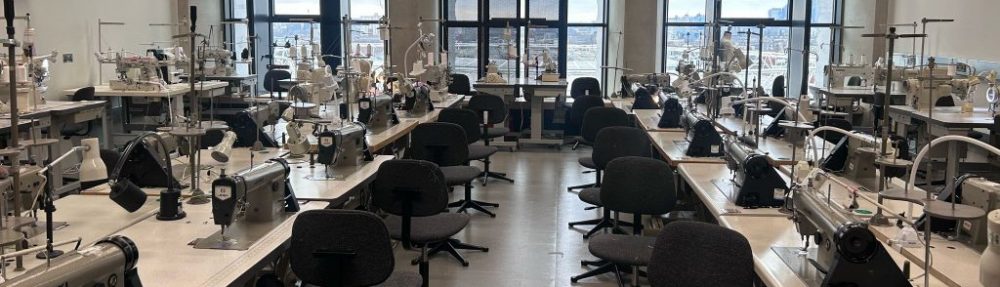
I’ve been reflecting on my intentions regarding using ‘scaffolding’ as a term to explain supporting students to become confident independent learners in the sewing studio. I am researching and working to improve handouts to ensure students are ‘scaffolded’ and supported while learning difficult sewing techniques at their own pace. Reading Shvarts and Baker’s (2019) exploration of the history of the scaffolding metaphor helped me to question both its purpose and its limits.
Shvarts and Baker (2019) argue that scaffolding has become a “vague and polysemic” concept in education (p.5). I’ve often assumed that by adding clearer instructions and more diagrams, I’m automatically improving students’ learning experiences. How can I be sure that this support is genuinely helpful?
Scaffolding is not intended to be long-term support. Luria and Vygotsky describe it as temporary and transitional, designed to be removed once learners no longer need it. They explain that support should be discarded “as no more external help is needed” (1930/1992, p.145). Students are free to use the handouts to support their sewing until they feel confident in their capabilities and then no longer need to rely on them.
My practice and research is grounded in Universal Design for Learning (UDL). UDL aims to provide ‘multiple means of representation’, allowing students to access content in ways that suit them and gradually build independence (Meyer, Rose and Glass, 2014). Within this, redesigned handouts act as flexible scaffolds: offering structure through clarity and supporting visuals.
Shvarts and Baker (2019) trace the scaffolding metaphor back to Bernstein’s work on reducing ‘degrees of freedom’ when learning new skills. Bernstein described how beginners initially restrict movement to manage complex tasks before developing fluency (Bernstein, 1967). I am often teaching to students with limited sewing experience and knowledge complex techniques used in contour garment construction. Scaffolding through improved handouts allows the students to return to learning resources as and when they need them. It lets them reflect and try by themselves before asking for help; a bridge to help them become more independent learners. The help from technicians is always there should they need it, but some students do not like to ask for help. The new handouts should help improve their independent learning.
By breaking handouts down into manageable steps using diagrams and annotations, I aim to help students focus on ‘understanding before automation’. This reflects what Wood, Bruner and Ross (1976) describe as simplifying tasks by ‘reducing the number of constituent acts’ (p.98).
Shvarts and Baker also caution against scaffolding becoming ‘overly prescriptive’. Griffin and Cole (1984) warn that it can assume fixed goals, limiting creativity. This creates tension in my role as a technician. Students need to complete garments in the demonstrated way to understand core methods of make. There is no flexibility when constructing demonstration garments together, required as part of their hand in submission. UDL helps me navigate this by re framing choice. Rather than altering the task itself, I can offer options through multiple formats of learning and engagement, including:
- Live, in-person workshop demonstrations
- The option for students to record and revisit demonstrations in their own time
- Improved technical handouts
- Supervised studio time and 1-to-1 support
Shvarts and Baker (2019) emphasise that scaffolding isnt fixed. It depends on the specific situation, the student and their learning differences or needs. It must respond to learners rather than impose a fixed structure. By inviting students to critique the handouts during a focus group, I want to test if these materials support autonomy or constrain it. Their feedback will shape the next version, ensuring the handouts remain collaborative.
This paper helped me realise that scaffolding is about trust, both from the student and the teacher (in this instance, technician). Improved handouts offer students an additional resource they can return to until techniques are familiar and understood. This benefits all learners, but is especially supportive for neurodivergent students and those studying in a second language, closely aligning with the principles of UDL.
Bibliography
Bernstein, A.N. (1967) The co-ordination and regulation of movements. Oxford: Pergamon Press.
Griffin, P. and Cole, M. (1984) ‘Current activity for the future: The Zo-ped’, New Directions for Child and Adolescent Development, 1984(23), pp. 45–64.
Luria, A.R. and Vygotsky, L.S. (1992) Ape, primitive man, and child: Essays in the history of behaviour. Translated by E. Rossiter. New York: Harvester Wheatsheaf.
Meyer, A., Rose, D.H. and Gordon, D. (2014) Universal Design for Learning: Theory and practice. Wakefield, MA: CAST.
Shvarts, A. and Baker, A. (2019) ‘The early history of the scaffolding metaphor: Bernstein, Luria, Vygotsky and before’, Mind, Culture, and Activity, 26(1), pp. 4–23. https://doi.org/10.1080/10749039.2019.1574306
Wood, D., Bruner, J.S. and Ross, G. (1976) ‘The role of tutoring in problem-solving’, Journal of Child Psychology and Psychiatry, 17(2), pp. 89–100.